

CreativeExplorer-MichaelMandaville.com
I work in Film. I live in Martial Arts. I thrive in Imagination.


"Journey So Dreams May Come" - Discussion Guide - CLICK THATAWAY >






What is the 5/25/70% imbalance and its meaning for America?
In today’s context (mid-2020s), these 5/25/70% percentages explains tensions around BRICS, Saudi oil deals in non-dollars, China’s yuan internationalization, and U.S. efforts to defend dollar supremacy.
Whether the U.S. can keep the ~5/25/70 imbalance going determines if the “empire” phase extends or ends — exactly as the statement warns. It’s a concise way of saying: reserve-currency status isn’t just economics; it’s the hidden glue of geopolitical power. Lose it, and the fall accelerates. Questions abound about about the petrodollar system, Iraqi oil trading, and how empires enforce dollar dominance (e.g., historical cases like Saddam Hussein switching to euros). World currency control acts as a subtle but powerful mechanism that sustains (or dooms) empires.
The ~5/25/70 thresholds are the core reason most empires eventually decline — failing to maintain them is “only a matter of time.”
What Are the ~5/25/70 Thresholds?
This is shorthand for a classic geopolitical-economic observation about currency hegemony (when one nation’s currency becomes the world’s dominant reserve, trade, and financial currency). It highlights the extreme disproportion that gives the issuing empire outsized power:
~5%: The empire’s share of world population (the U.S. is currently ~4.2–5%).
~25%: The empire’s share of world GDP (or economic output/resources; the U.S. has hovered around 25–26% nominal GDP for decades).
~70% (or higher historically): The dominant currency’s share of global foreign-exchange reserves, trade invoicing, or cross-border financial flows (USD reserves peaked near 70%+ in the early 2000s and were even higher in some metrics like FX transactions).
A tiny slice of humanity, with only about a quarter of global economic output, somehow controls the vast majority of the world’s money. This is not natural market outcome alone — it’s sustained by geopolitics, military power, alliances, and network effects (everyone uses it because everyone else uses it).
How This Relates to Geopolitics and Currency DominationCurrency domination (today, the U.S. dollar’s “exorbitant privilege”) is a force multiplier for empire: Financing power without immediate pain: The issuing country can run large deficits, print money that foreigners happily hold, and borrow cheaply. This funds massive military spending and global projection of power.
Sanctions as a weapon: Control the currency = control access to the global financial system (SWIFT, dollar clearing, etc.). The U.S. has weaponized this against Russia, Iran, etc., without firing a shot. Petrodollar and commodity links: Much of the world’s oil, commodities, and trade are priced/invoiced in dollars. This creates constant demand for USD (recycling “petrodollars” back into U.S. Treasuries). Self-reinforcing cycle: High GDP share + military alliances + currency dominance create a feedback loop. Challengers (e.g., China’s yuan push, BRICS de-dollarization efforts) threaten to break it.
Historical parallels are clear: The British pound lost dominance as the UK’s GDP share shrank post-WWII; the Dutch guilder before that. Empires that lose currency hegemony see their “free lunch” end — deficits become painful, military overstretch unsustainable, and influence erodes.Why This Is “Arguably the Main Reason” Empires “Mostly” FallThe commenter argues this is the real structural vulnerability, more than just military defeat or internal decay:As long as the thresholds hold (tiny population + solid GDP share + overwhelming currency control), the empire can punch far above its weight.
When they slip — relative GDP decline (rise of China/others), de-dollarization (even gradual), or loss of trust in the currency — the whole system unravels. Military power depends on economic/financial power. Lose the currency “control mechanism” and the ability to fund the empire cheaply collapses.
It’s “only a matter of time” because history shows no empire maintains these thresholds forever. Economic gravity (rising challengers, overextension, domestic mismanagement) eventually erodes them.


Did You Know...
... if you improve 1/2% each day, then you will be 267% better over one year? Who can compete with that?
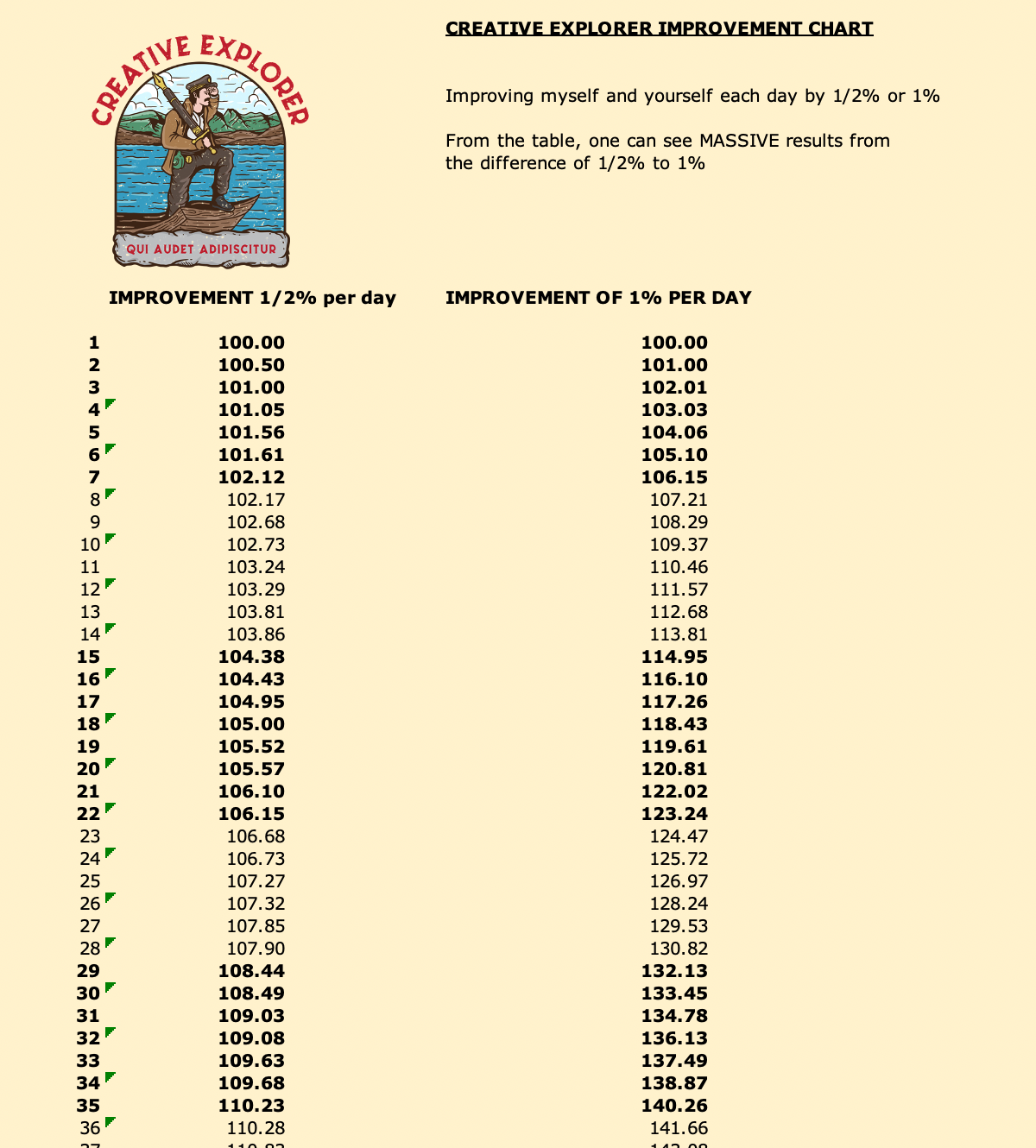
Setting Yourself Up for Success usually doesn't mean one big jump but rather incremental change day after day. Think of it like a ocean wave, moving far out in the Pacific with almost an undetectable push...finally with the power and grace of an ocean wave onto the beach. Create your own metaphor to embrace small habits with a huge future impact.
