

Mars is attainable if we're all pulling with most of the same oars. How the hell do we do that? And then guess, each country earns votes. And if you're not actively working to earn votes, then the entire world and other country will know that you're just a fuckup of a country run by jerkoffs who should be overthrown.
Simple. Who's not tired of poseur diplomats in the UN eating at fancy restaurants and dodging their parking tickets in the US?
Two Steps. Common Understanding and a Earned Voting Points system.
First, we need a common understanding of criteria and not the usual elitist virtual signaling nonsense. Actual goals scientific in nature and defined perhaps in Encylopedia Galactica. Much like Elon shooting a Starship into the heavens, we need to approach governance like physics. We can start with 7 core principles of science to build this list:
Empirical Evidence: Scientific claims are based on direct observation or experimentation, not on unsupported opinions.
Objectivity: Scientists aim to minimize bias and personal beliefs in their work to ensure findings reflect reality.
Replicability/Repeatability: Experiments and studies must be able to be reproduced by other researchers to verify the results.
Falsifiability: A scientific hypothesis or theory must be stated in a way that it can be proven false.
Systematic Observation: Science relies on organized methods, such as the scientific method, to gather data.
Tentativeness/Changeability: Scientific knowledge is not absolute and is subject to revision or refinement as new evidence becomes available.
Theoretical Framework/Models: Science aims to explain natural phenomena through testable theories and models that bring coherence to empirical data.
The United Nations, once a noble experiment, is now a distorted group of elitists who engender corruption, incompetence and excess. Articles on United Nations (UN) incompetence and corruption often highlight systemic bureaucracy, lack of accountability, and failures in peacekeeping operations, such as sexual exploitation or inaction during crises. Key issues include the Security Council's failure to prevent conflicts, financial mismanagement, and resistance to transparency. You can research articles on UN corruption but here's one.
Iran dealing with human rights? Does anybody remember Oil for food scandals? Pathetic peacekeeping efforts? Sexual abuse by UN members? On and on and on. It's worse than some hyped up drama bullshit pumped by Netflix on a desperate Friday night.
But why does a country like Iran, Sudan, Somalia, Burma and others have the same vote as the United States or France or Japan? Yes, the US is on the Security Council. But I think that the United Nations needs to institute a points system.
Each country has 100 possible votes . But you have to qualify. Not sure if any country would swing the full 100 votes. The list is subject to revision.
But here's the first stab at the list.
Structured Criteria for Earning Voting Points in a Reformed United Nations System
This framework evaluates countries based on governance, human rights, economic policies, social policies, environmental efforts, defense, cultural contributions, technological advancements, global cooperation, and adherence to international laws. Each criterion is assigned a specific point value, with a total of 100 points.
Governance and Rule of Law (20 points)
Spell the name of your country correctly – 1 point
Transparent and fair elections – 4 points
Independent judiciary – 4 points
Anti-corruption measures in government – 4 points
Adherence to agreed international law – 2 points
No political prisoners – 3 points
Equal representation in government for all citizens – 2 points
Subtotal: 20 points
Human Rights (20 points)
Freedom of press – 3 points
Freedom of speech – 3 points
Freedom of assembly – 3 points
Freedom of religion – 3 points
Human rights -other TBD – 4 points
No use of torture – 2 points
No child labor – 2 points
Subtotal: 20 points
Economic Policies (10 points)
Free trade agreements – 1 point
Ease of starting a business – 1 point
Transparent tax policies – 1 point
Fair labor laws – 1 point
Intellectual property protections – 1 point
Open markets for foreign investment – 1 point
Stable currency and low inflation – 2 points
No excessive tariffs – 1 point
Low corruption in trade – 1 point
Subtotal: 10 points
Social Policies (10 points)
Reasonable access to education – 2 points
Reasonable access to healthcare – 2 points
Gender equality in education and employment – 2 points
Support for disabled individuals – 1 point
Access to clean water and electricity – 2 points
Affordable housing policies – 1 point
Subtotal: 10 points
Environmental Policies (10 points)
Commitment to reducing carbon emissions – 1 points
Participation in global climate agreements – 1 point
Protection of endangered species – 2 point
Renewable energy initiatives – 2 points
Waste management and recycling programs – 1 point
Clean air and water conservation policies – 2 points
Sustainable agriculture practices – 1 point
Subtotal: 10 points
Defense and Security (10 points)
Limited military actions – 3 points
Participation in peacekeeping missions – 2 points
Nuclear Weapons safety systems – 2 points
Transparency in military spending – 1 point
Cybersecurity measures – 1 point
Border security – 1 point
Subtotal: 10 points
Cultural and Educational Contributions (5 points)
Protection of cultural heritage and language – 1 point
Promotion of arts and culture – 1 point
Support for scientific research – 1 point
Scholarships for approved nternational students – 1 point
Public libraries and access to knowledge – 1 point
Subtotal: 5 points
Technological and Innovation Policies (5 points)
Investment in technology and innovation – 2 points
Internet access for all citizens – 1 point
Data privacy protections – 1 point
Ethical AI development policies – 1 point
Subtotal: 5 points
Global Cooperation (5 points)
Participation in infrastructure building missions – 1 point
Contributions to transparent global humanitarian aid – 1 point
Refugee who are verified resettlement programs – 1 point
Support for global health initiatives – 1 point
Commitment to Economic Development – 1 point
Subtotal: 5 points
Miscellaneous (5 points)
No human trafficking – 1 point
No forced labor – 1 point
No systemic racism – 1 point
No gender-based violence – 1 point
No state-sponsored terrorism – 1 point
Subtotal: 5 points
Grand Total: 100 Points
Will this work perfectly? Hell no, because it was created by a human so it always works partially but it's a lot better than people sitting around and being nice to assholes in another country who abuse women, scam their economies and make extra dough on the side through deals with cartels.
Countries like Sudan and Somalia would have a long way to go. Norway could probably coast. The US, the new Republic of Alberta, most of Europe and Japan pretty good shape. But time to do something radical with transparency and accountability. You see, humanity has moved forward with amazing inventions from the industrial revolution to Starlink and everything in between. Just think of it: electricity, ships, vehicles, rockets, internet, penicillin, X rays and on and on. Thomas Edison would be proud as would Tesla and Marie Curie and the Lumiere Brothers and more.
We need to reinvent governance. Now to be clear, I am an American and believe in American sovereignty and its exceptionalism. Global governance is foolish. The EU is one example where you cannot reconcile Finns with Spaniards. The EU might be a worthy trade bloc but it's utter crap for overall governance and now is just an authoritarian junk mill of globalist asshats.
What I'm talking about is better and accountable cooperation by accountable action. Maybe this is one way. Maybe one of you geniuses has a better way. If it's better, I'll take it.
If we want to get to Mars, then radical thinking is needed. @elonmusk got Mars covered I have no doubt.
We have the hard part. We have to fix Earth.
Let's roll.


Mars is attainable if we're all pulling with most of the same oars. How the hell do we do that? And then guess, each country earns votes. And if you're not actively working to earn votes, then the entire world and other country will know that you're just a fuckup of a country run by jerkoffs who should be overthrown.
Simple. Who's not tired of poseur diplomats in the UN eating at fancy restaurants and dodging their parking tickets in the US?
Two Steps. Common Understanding and a Earned Voting Points system.
First, we need a common understanding of criteria and not the usual elitist virtual signaling nonsense. Actual goals scientific in nature and defined perhaps in Encylopedia Galactica. Much like Elon shooting a Starship into the heavens, we need to approach governance like physics. We can start with 7 core principles of science to build this list:
Empirical Evidence: Scientific claims are based on direct observation or experimentation, not on unsupported opinions.
Objectivity: Scientists aim to minimize bias and personal beliefs in their work to ensure findings reflect reality.
Replicability/Repeatability: Experiments and studies must be able to be reproduced by other researchers to verify the results.
Falsifiability: A scientific hypothesis or theory must be stated in a way that it can be proven false.
Systematic Observation: Science relies on organized methods, such as the scientific method, to gather data.
Tentativeness/Changeability: Scientific knowledge is not absolute and is subject to revision or refinement as new evidence becomes available.
Theoretical Framework/Models: Science aims to explain natural phenomena through testable theories and models that bring coherence to empirical data.
The United Nations, once a noble experiment, is now a distorted group of elitists who engender corruption, incompetence and excess. Articles on United Nations (UN) incompetence and corruption often highlight systemic bureaucracy, lack of accountability, and failures in peacekeeping operations, such as sexual exploitation or inaction during crises. Key issues include the Security Council's failure to prevent conflicts, financial mismanagement, and resistance to transparency. You can research articles on UN corruption but here's one.
Iran dealing with human rights? Does anybody remember Oil for food scandals? Pathetic peacekeeping efforts? Sexual abuse by UN members? On and on and on. It's worse than some hyped up drama bullshit pumped by Netflix on a desperate Friday night.
But why does a country like Iran, Sudan, Somalia, Burma and others have the same vote as the United States or France or Japan? Yes, the US is on the Security Council. But I think that the United Nations needs to institute a points system.
Each country has 100 possible votes . But you have to qualify. Not sure if any country would swing the full 100 votes. The list is subject to revision.
But here's the first stab at the list.
Structured Criteria for Earning Voting Points in a Reformed United Nations System
This framework evaluates countries based on governance, human rights, economic policies, social policies, environmental efforts, defense, cultural contributions, technological advancements, global cooperation, and adherence to international laws. Each criterion is assigned a specific point value, with a total of 100 points.
Governance and Rule of Law (20 points)
Spell the name of your country correctly – 1 point
Transparent and fair elections – 4 points
Independent judiciary – 4 points
Anti-corruption measures in government – 4 points
Adherence to agreed international law – 2 points
No political prisoners – 3 points
Equal representation in government for all citizens – 2 points
Subtotal: 20 points
Human Rights (20 points)
Freedom of press – 3 points
Freedom of speech – 3 points
Freedom of assembly – 3 points
Freedom of religion – 3 points
Human rights -other TBD – 4 points
No use of torture – 2 points
No child labor – 2 points
Subtotal: 20 points
Economic Policies (10 points)
Free trade agreements – 1 point
Ease of starting a business – 1 point
Transparent tax policies – 1 point
Fair labor laws – 1 point
Intellectual property protections – 1 point
Open markets for foreign investment – 1 point
Stable currency and low inflation – 2 points
No excessive tariffs – 1 point
Low corruption in trade – 1 point
Subtotal: 10 points
Social Policies (10 points)
Reasonable access to education – 2 points
Reasonable access to healthcare – 2 points
Gender equality in education and employment – 2 points
Support for disabled individuals – 1 point
Access to clean water and electricity – 2 points
Affordable housing policies – 1 point
Subtotal: 10 points
Environmental Policies (10 points)
Commitment to reducing carbon emissions – 1 points
Participation in global climate agreements – 1 point
Protection of endangered species – 2 point
Renewable energy initiatives – 2 points
Waste management and recycling programs – 1 point
Clean air and water conservation policies – 2 points
Sustainable agriculture practices – 1 point
Subtotal: 10 points
Defense and Security (10 points)
Limited military actions – 3 points
Participation in peacekeeping missions – 2 points
Nuclear Weapons safety systems – 2 points
Transparency in military spending – 1 point
Cybersecurity measures – 1 point
Border security – 1 point
Subtotal: 10 points
Cultural and Educational Contributions (5 points)
Protection of cultural heritage and language – 1 point
Promotion of arts and culture – 1 point
Support for scientific research – 1 point
Scholarships for approved nternational students – 1 point
Public libraries and access to knowledge – 1 point
Subtotal: 5 points
Technological and Innovation Policies (5 points)
Investment in technology and innovation – 2 points
Internet access for all citizens – 1 point
Data privacy protections – 1 point
Ethical AI development policies – 1 point
Subtotal: 5 points
Global Cooperation (5 points)
Participation in infrastructure building missions – 1 point
Contributions to transparent global humanitarian aid – 1 point
Refugee who are verified resettlement programs – 1 point
Support for global health initiatives – 1 point
Commitment to Economic Development – 1 point
Subtotal: 5 points
Miscellaneous (5 points)
No human trafficking – 1 point
No forced labor – 1 point
No systemic racism – 1 point
No gender-based violence – 1 point
No state-sponsored terrorism – 1 point
Subtotal: 5 points
Grand Total: 100 Points
Will this work perfectly? Hell no, because it was created by a human so it always works partially but it's a lot better than people sitting around and being nice to assholes in another country who abuse women, scam their economies and make extra dough on the side through deals with cartels.
Countries like Sudan and Somalia would have a long way to go. Norway could probably coast. The US, the new Republic of Alberta, most of Europe and Japan pretty good shape. But time to do something radical with transparency and accountability. You see, humanity has moved forward with amazing inventions from the industrial revolution to Starlink and everything in between. Just think of it: electricity, ships, vehicles, rockets, internet, penicillin, X rays and on and on. Thomas Edison would be proud as would Tesla and Marie Curie and the Lumiere Brothers and more.
We need to reinvent governance. Now to be clear, I am an American and believe in American sovereignty and its exceptionalism. Global governance is foolish. The EU is one example where you cannot reconcile Finns with Spaniards. The EU might be a worthy trade bloc but it's utter crap for overall governance and now is just an authoritarian junk mill of globalist asshats.
What I'm talking about is better and accountable cooperation by accountable action. Maybe this is one way. Maybe one of you geniuses has a better way. If it's better, I'll take it.
If we want to get to Mars, then radical thinking is needed. @elonmusk got Mars covered I have no doubt.
We have the hard part. We have to fix Earth.
Let's roll.

Mars is attainable if we're all pulling with most of the same oars. How the hell do we do that? And then guess, each country earns votes. And if you're not actively working to earn votes, then the entire world and other country will know that you're just a fuckup of a country run by jerkoffs who should be overthrown.
Simple. Who's not tired of poseur diplomats in the UN eating at fancy restaurants and dodging their parking tickets in the US?
Two Steps. Common Understanding and a Earned Voting Points system.
First, we need a common understanding of criteria and not the usual elitist virtual signaling nonsense. Actual goals scientific in nature and defined perhaps in Encylopedia Galactica. Much like Elon shooting a Starship into the heavens, we need to approach governance like physics. We can start with 7 core principles of science to build this list:
Empirical Evidence: Scientific claims are based on direct observation or experimentation, not on unsupported opinions.
Objectivity: Scientists aim to minimize bias and personal beliefs in their work to ensure findings reflect reality.
Replicability/Repeatability: Experiments and studies must be able to be reproduced by other researchers to verify the results.
Falsifiability: A scientific hypothesis or theory must be stated in a way that it can be proven false.
Systematic Observation: Science relies on organized methods, such as the scientific method, to gather data.
Tentativeness/Changeability: Scientific knowledge is not absolute and is subject to revision or refinement as new evidence becomes available.
Theoretical Framework/Models: Science aims to explain natural phenomena through testable theories and models that bring coherence to empirical data.
The United Nations, once a noble experiment, is now a distorted group of elitists who engender corruption, incompetence and excess. Articles on United Nations (UN) incompetence and corruption often highlight systemic bureaucracy, lack of accountability, and failures in peacekeeping operations, such as sexual exploitation or inaction during crises. Key issues include the Security Council's failure to prevent conflicts, financial mismanagement, and resistance to transparency. You can research articles on UN corruption but here's one.
Iran dealing with human rights? Does anybody remember Oil for food scandals? Pathetic peacekeeping efforts? Sexual abuse by UN members? On and on and on. It's worse than some hyped up drama bullshit pumped by Netflix on a desperate Friday night.
But why does a country like Iran, Sudan, Somalia, Burma and others have the same vote as the United States or France or Japan? Yes, the US is on the Security Council. But I think that the United Nations needs to institute a points system.
Each country has 100 possible votes . But you have to qualify. Not sure if any country would swing the full 100 votes. The list is subject to revision.
But here's the first stab at the list.
Structured Criteria for Earning Voting Points in a Reformed United Nations System
This framework evaluates countries based on governance, human rights, economic policies, social policies, environmental efforts, defense, cultural contributions, technological advancements, global cooperation, and adherence to international laws. Each criterion is assigned a specific point value, with a total of 100 points.
Governance and Rule of Law (20 points)
Spell the name of your country correctly – 1 point
Transparent and fair elections – 4 points
Independent judiciary – 4 points
Anti-corruption measures in government – 4 points
Adherence to agreed international law – 2 points
No political prisoners – 3 points
Equal representation in government for all citizens – 2 points
Subtotal: 20 points
Human Rights (20 points)
Freedom of press – 3 points
Freedom of speech – 3 points
Freedom of assembly – 3 points
Freedom of religion – 3 points
Human rights -other TBD – 4 points
No use of torture – 2 points
No child labor – 2 points
Subtotal: 20 points
Economic Policies (10 points)
Free trade agreements – 1 point
Ease of starting a business – 1 point
Transparent tax policies – 1 point
Fair labor laws – 1 point
Intellectual property protections – 1 point
Open markets for foreign investment – 1 point
Stable currency and low inflation – 2 points
No excessive tariffs – 1 point
Low corruption in trade – 1 point
Subtotal: 10 points
Social Policies (10 points)
Reasonable access to education – 2 points
Reasonable access to healthcare – 2 points
Gender equality in education and employment – 2 points
Support for disabled individuals – 1 point
Access to clean water and electricity – 2 points
Affordable housing policies – 1 point
Subtotal: 10 points
Environmental Policies (10 points)
Commitment to reducing carbon emissions – 1 points
Participation in global climate agreements – 1 point
Protection of endangered species – 2 point
Renewable energy initiatives – 2 points
Waste management and recycling programs – 1 point
Clean air and water conservation policies – 2 points
Sustainable agriculture practices – 1 point
Subtotal: 10 points
Defense and Security (10 points)
Limited military actions – 3 points
Participation in peacekeeping missions – 2 points
Nuclear Weapons safety systems – 2 points
Transparency in military spending – 1 point
Cybersecurity measures – 1 point
Border security – 1 point
Subtotal: 10 points
Cultural and Educational Contributions (5 points)
Protection of cultural heritage and language – 1 point
Promotion of arts and culture – 1 point
Support for scientific research – 1 point
Scholarships for approved nternational students – 1 point
Public libraries and access to knowledge – 1 point
Subtotal: 5 points
Technological and Innovation Policies (5 points)
Investment in technology and innovation – 2 points
Internet access for all citizens – 1 point
Data privacy protections – 1 point
Ethical AI development policies – 1 point
Subtotal: 5 points
Global Cooperation (5 points)
Participation in infrastructure building missions – 1 point
Contributions to transparent global humanitarian aid – 1 point
Refugee who are verified resettlement programs – 1 point
Support for global health initiatives – 1 point
Commitment to Economic Development – 1 point
Subtotal: 5 points
Miscellaneous (5 points)
No human trafficking – 1 point
No forced labor – 1 point
No systemic racism – 1 point
No gender-based violence – 1 point
No state-sponsored terrorism – 1 point
Subtotal: 5 points
Grand Total: 100 Points
Will this work perfectly? Hell no, because it was created by a human so it always works partially but it's a lot better than people sitting around and being nice to assholes in another country who abuse women, scam their economies and make extra dough on the side through deals with cartels.
Countries like Sudan and Somalia would have a long way to go. Norway could probably coast. The US, the new Republic of Alberta, most of Europe and Japan pretty good shape. But time to do something radical with transparency and accountability. You see, humanity has moved forward with amazing inventions from the industrial revolution to Starlink and everything in between. Just think of it: electricity, ships, vehicles, rockets, internet, penicillin, X rays and on and on. Thomas Edison would be proud as would Tesla and Marie Curie and the Lumiere Brothers and more.
We need to reinvent governance. Now to be clear, I am an American and believe in American sovereignty and its exceptionalism. Global governance is foolish. The EU is one example where you cannot reconcile Finns with Spaniards. The EU might be a worthy trade bloc but it's utter crap for overall governance and now is just an authoritarian junk mill of globalist asshats.
What I'm talking about is better and accountable cooperation by accountable action. Maybe this is one way. Maybe one of you geniuses has a better way. If it's better, I'll take it.
If we want to get to Mars, then radical thinking is needed. @elonmusk got Mars covered I have no doubt.
We have the hard part. We have to fix Earth.
Let's roll.

Did You Know...
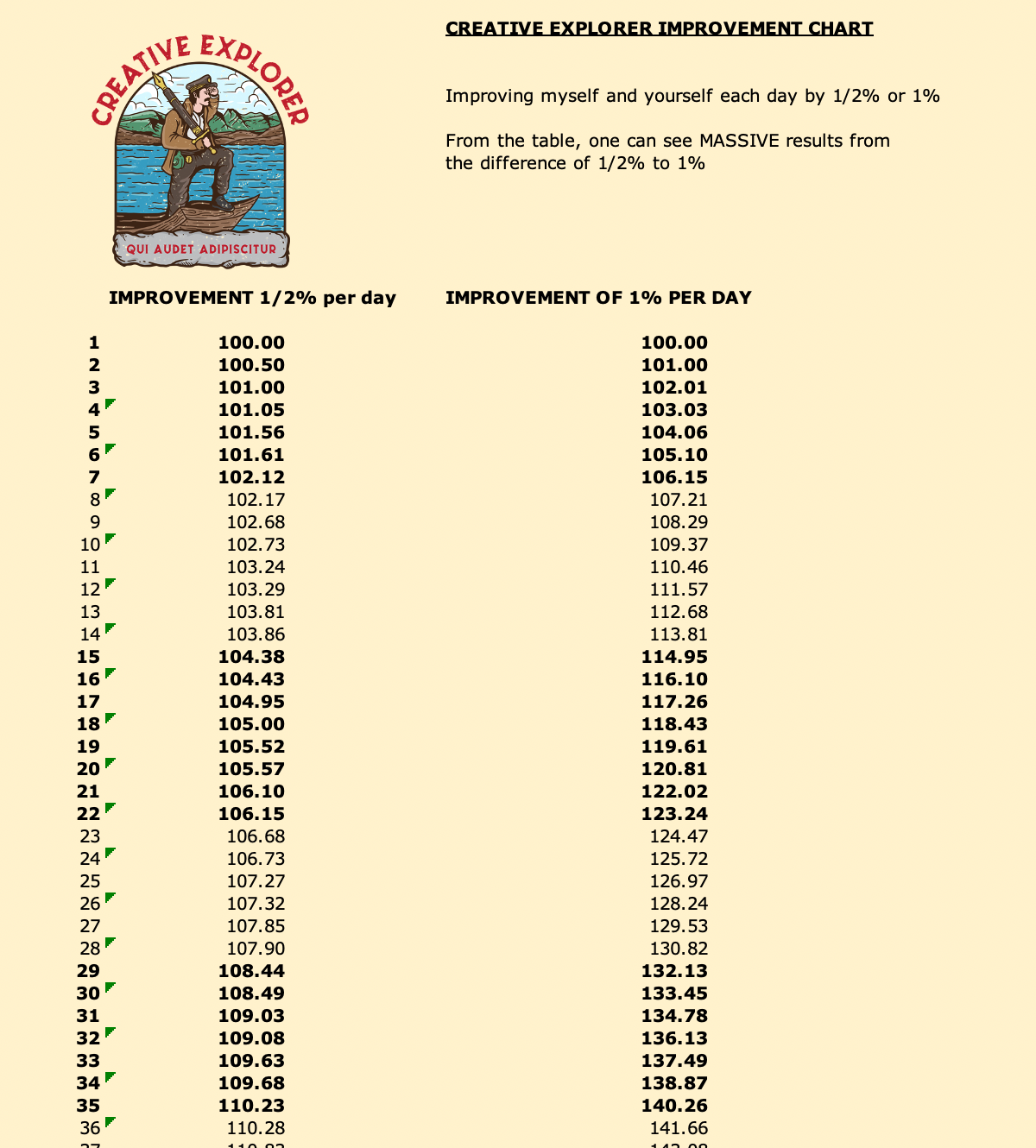
... if you improve 1/2% each day, then you will be 267% better over one year? Who can compete with that?

Facebook
Instagram
X
LinkedIn
Youtube
Website