You Fight for Freedom. Are You Being Tailed?
Urban Surveillance Detection
Knowing whether you're being followed on foot in a city is a learnable skill, not a paranoid instinct.
I have worked and visited various locations around the world where, as a tourist or filmmaker, I could be sized up for a robbery, scam or assault or worse. In my hometown of Los Angeles, I've definitely worked in dangerous areas on film sets - which had security - but were in heavily drug and gang infested areas. Like MacArthur Park in Los Angeles. I remember when my father took me as a child to that park to play. No longer.
I've also worked in Korea, France, Egypt and Dubai. I've traveled to most of Europe, Canada, Mexico, Central and South America as well as Morocco, Romania, Hungary, Iceland and more.
In addition, if you are fighting today for Free Speech, Women's Rights, Border Security and reduced crime, enough crazy fanatics are out there who might follow you home, attack you or your home. Don't believe me? Research headlines.
Surveillance detection—a core discipline of intelligence tradecraft—teaches you to read behavioral patterns, confirm suspicions through deliberate testing, and break away safely without revealing where you live. This guide draws on techniques used by former CIA covert operatives and Special Forces operators to help civilians, professionals, and anyone in sensitive work recognize a tail, verify it, and lose it. What follows is a practical framework built on situational awareness, confirmation methods, and counter-surveillance measures you can apply the moment something feels off.

Key Takeaways
Being followed is detectable through behavioral pattern recognition. Once you understand what "normal" looks like in your surroundings, a follower's anomalies stand out.
Situational awareness starts with baseline behavior. Study the people, pace, and rhythms of an area so you can spot what doesn't belong.
Confirmation relies on deliberate testing—changing pace, making unexpected turns, and using the multi-stop method to force a follower to reveal intent.
Counter-surveillance means breaking line of sight and moving into CCTV-monitored public spaces where a follower must either expose themselves or disengage.
Never lead a follower home. Go to a safe, public location and alert authorities instead.
How can you tell if someone is following you in a city?
You can tell someone is following you when their movements consistently mirror yours across changes in pace, direction, and location that a normal passerby wouldn't replicate. A single shared turn means nothing. A pattern—matching your speed, stopping when you stop, reappearing after you double back—is the signal that matters.
Human behavior in public spaces is largely predictable. People walk with purpose toward a destination, rarely retrace their steps, and don't loiter without reason. A follower breaks these patterns because their destination is you. The skill lies in noticing those breaks before they notice you noticing.
Detection blends three things: psychological insight into how people move, physical awareness of your surroundings, and a working knowledge of urban dynamics. None of it requires special equipment. It requires attention.
What is surveillance detection?
Surveillance detection is the practice of identifying whether you are under observation by studying your environment and testing suspicious behavior. It is a foundational element of intelligence tradecraft, refined through training and field experience.
The discipline rests on four pillars:
Baseline behavior. Learn the normal patterns of an area—who frequents it, how they move, what the usual rhythm looks like. Anomalies only reveal themselves against a known baseline.
Observation. Keep your peripheral vision active. Use reflections in windows, mirrors, and glass storefronts to check behind you without turning your head or signaling awareness.
Situational awareness. Always know your location, your possible escape routes, and your nearest safe points, such as police stations or crowded public venues.
The sixth sense. Trust your instincts. If something feels wrong, it often is. Your subconscious detects threats before your conscious mind can put them into words.
Together, these habits turn a routine walk into a low-effort, continuous read of your surroundings.
How do you confirm you're being followed on foot?
You confirm a tail by introducing deliberate, unusual actions and watching whether the suspected follower adapts to match them. A legitimate passerby continues toward their own destination. A follower adjusts to stay with you.
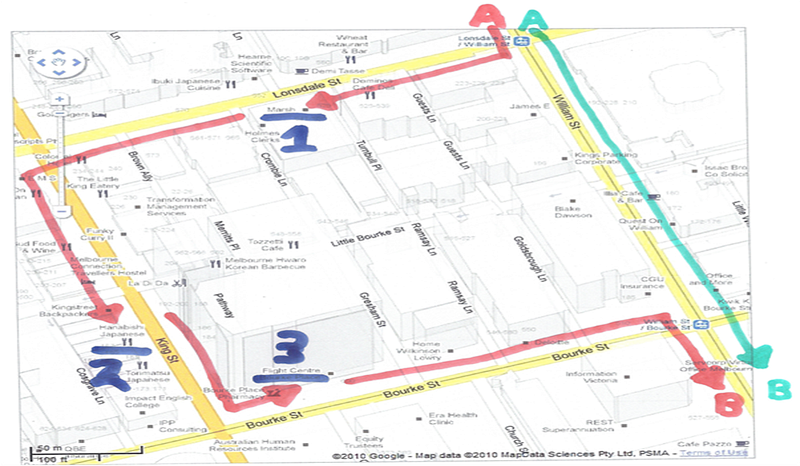
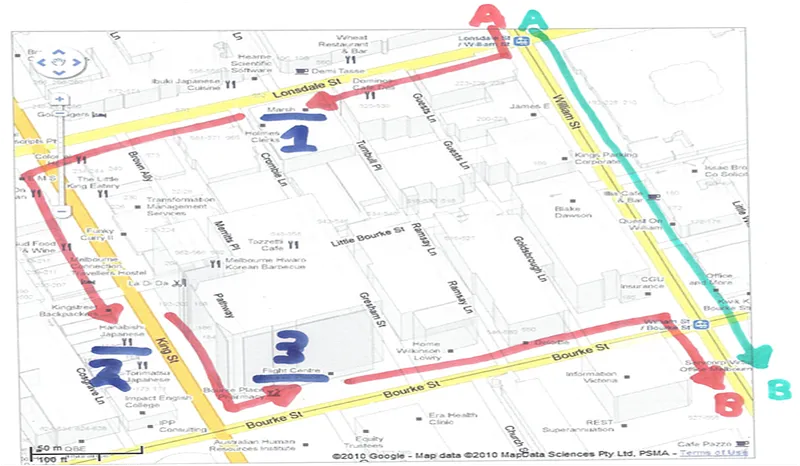
By running a surveillance detection route of "Three Sides to a Square", you consciously force anyone from following to take an 'illogical route" like this to expose the 'tail'.
Intelligence operatives rely on a set of tested confirmation techniques:
Technique: What you do. What it reveals
Change pace: Slow down or speed up noticeably. A follower matching your new speed exposes coordination
Stop and go: Abruptly stop to tie a shoe or check your phone. Forces a tail into a quick, revealing decision
Direction change: Make an unexpected turn or double back. Normal pedestrians rarely mimic this
Route variation: Break from a route you normally take. Consistency makes you an easy target; variation flushes out watchers
Multi-stop method: Enter several unrelated stores in quick succession. Repeated shared stops betray a follower
Transportation switch: Exit public transport, then immediately board another line or mode going a different direction. A follower who follows the switch confirms intent/ The logic behind each is the same: create a situation where a follower must make a choice, and let that choice give them away.
What is the multi-stop method for detecting surveillance?
The multi-stop method involves making several stops in a short period at places where it would be unnatural for the same person to stop alongside you. It's one of the clearest ways to confirm a tail.
Here's why it works. If you step into a hardware store, then a pharmacy, then a bookshop within twenty minutes, a genuine stranger has no plausible reason to appear at all three. Their errands and yours would not realistically overlap that neatly. When the same face turns up stop after stop, coincidence collapses and intent becomes obvious.
The method is powerful because it stacks probability against the follower. Each additional unrelated stop multiplies the unlikelihood of innocent overlap—forcing them to either break contact or accept exposure.
What counter-surveillance measures shake a tail?
Once you've confirmed you're being followed, counter-surveillance measures let you break contact and reach safety. These range from simple maneuvers to more involved actions depending on the threat.
Break line of sight. Use buildings, buses, or other physical barriers to disappear from a follower's view, even briefly. Each break forces them to commit to catching up—or lose you.
Enter a public space. Step into a café or bookstore, ideally one with CCTV. Watch whether the person follows you in and note their behavior. Cameras create a record and raise the cost of exposure for a watcher.
Lose the tail. Shake a confirmed follower through sudden turns, by blending into a crowd, or by changing your appearance—removing a jacket, adding a hat, altering your silhouette.
Do not go home. Leading a follower to your residence is the worst possible outcome. Head to a safe, public location instead.
Document what you can. If it's safe, capture evidence—photos, vehicle details, descriptions. This can prove critical later.
Engage security protocols. Operatives should activate their agency's procedures for compromised agents. Civilians should contact law enforcement.
The goal is never confrontation. It's to deny the follower their objective while keeping yourself, and your home, out of reach.
How do intelligence operatives shake a tail in urban environments?
Intelligence operatives shake a tail by layering confirmation and counter-surveillance into a single continuous sequence rather than reacting to a single moment. They treat detection as a discipline, not a panic response.
An operative moving through a city rarely takes the direct route. They vary their paths, build in natural-looking stops, and use the architecture of the environment—corners, transit hubs, crowds, CCTV zones—as tools. Line-of-sight breaks are chained together so a follower is repeatedly forced to close distance and expose themselves. Appearance changes and transportation switches are used to fracture a follower's picture of who they're chasing.
What separates a trained operative from an untrained civilian is not instinct but preparation. Constant vigilance and regular practice make these moves feel routine, so that under real pressure the response is automatic. This is why tradecraft rewards repetition: the maneuvers must be second nature before they're ever needed.
Practicing the skill before you need it
Detecting surveillance is a skill built through repetition, not something summoned in a crisis. The techniques covered here—reading baselines, confirming a tail through pace and direction tests, running the multi-stop method, breaking line of sight, and refusing to go home—work only if they're practiced until they're instinctive.
Start small. On an ordinary walk, note the baseline of your surroundings. Use a shop window to check behind you. Vary a route you take on autopilot. These low-stakes reps train the same awareness you'd rely on when it counts. In high-risk urban environments, that vigilance isn't optional—it's the difference between staying anonymous and being compromised.
For further study, explore related tradecraft on personal security, situational awareness, and risk assessment methods used by intelligence professionals.
Frequently Asked Questions
How can you tell if someone is following you in a city?
You can tell someone is following you when their movements repeatedly match yours across changes in pace, direction, and location that an ordinary passerby wouldn't copy. One shared turn is coincidence. A consistent pattern—matching your speed, stopping when you stop, reappearing after you double back—signals a follower whose destination is you.
What is surveillance detection?
Surveillance detection is the practice of identifying whether you're under observation by studying your environment and testing suspicious behavior. A core skill in intelligence tradecraft, it rests on four pillars: establishing baseline behavior, active observation using reflections, maintaining situational awareness of exits and safe points, and trusting your instincts when something feels off.
What should you do if you think you're being followed?
If you think you're being followed, first confirm it with deliberate tests—change pace, make an unexpected turn, or use the multi-stop method. Once confirmed, break line of sight, move into a public space with CCTV, and lose the tail through crowds or appearance changes. Never go home. Go to a safe, public location and contact law enforcement if needed.
What is the multi-stop method for detecting surveillance?
The multi-stop method means making several stops in a short window at unrelated places where it would be unnatural for the same stranger to appear alongside you—such as a hardware store, a pharmacy, and a bookshop in quick succession. If the same person turns up at multiple unrelated stops, coincidence becomes implausible and a tail is confirmed.
How do intelligence operatives shake a tail in urban environments?
Intelligence operatives shake a tail by combining confirmation and counter-surveillance into one continuous sequence. They vary routes, build in natural stops, break line of sight using buildings and transit, switch transportation, and change their appearance. Repeated practice makes these maneuvers automatic, so the response holds up under real pressure.
Meta data
Meta title
How to Tell if You're Being Followed in a City
Meta description
Learn surveillance detection tradecraft from former CIA operatives: how to spot, confirm, and lose a tail on foot in urban environments—without leading them home.